

Even today, gender stereotypes shape perceptions of leadership in the workplace. Charisma, authority, boldness, and unwavering confidence: these traits, often associated with men, create invisible yet powerful norms.
However, leadership does not depend on gender but rather on skills, attitude, and impact. To build a more equitable and high-performing environment, we must challenge these limiting beliefs.
In this article, we offer strategies to help you understand, break down, and take concrete action to promote inclusive and gender-balanced leadership. Because it is by working together that we will bring about lasting change in organizations.
First, let’s understand: what is a gender stereotype?
A gender stereotype is a rigid, often unconscious belief that attributes certain traits , behaviors, orskills to a person solely based on their gender.
For example: women are supposedly naturally gentle and not cut out for leadership; men are supposedly rational and destined for power. These stereotypes confine, limit, and hinder equitable access to leadership roles. And these stereotypes are far from gone.
In France, these stereotypes remain deeply entrenched, particularly from childhood onward in education and later in the workplace (source: DREES, 2024). Breaking down these biases is therefore the first step toward truly inclusive leadership.
What are the implications for the workplace?
Gender stereotypes have an impact on professional life. By unconsciously shaping perceptions of skills and potential, they contribute to an unfair work environment where the rules of the game are not the same for everyone.
They reinforce inequalities such as limited access to promotions, underrepresentation in strategic roles, and the assignment of less prestigious or more “caring” tasks to women… A pervasive glass ceiling.
These biases also affect mental health and well-being: feelings of illegitimacy, mental overload… When you’re constantly viewed through a gendered lens, you wear yourself out trying to “prove” your worth.
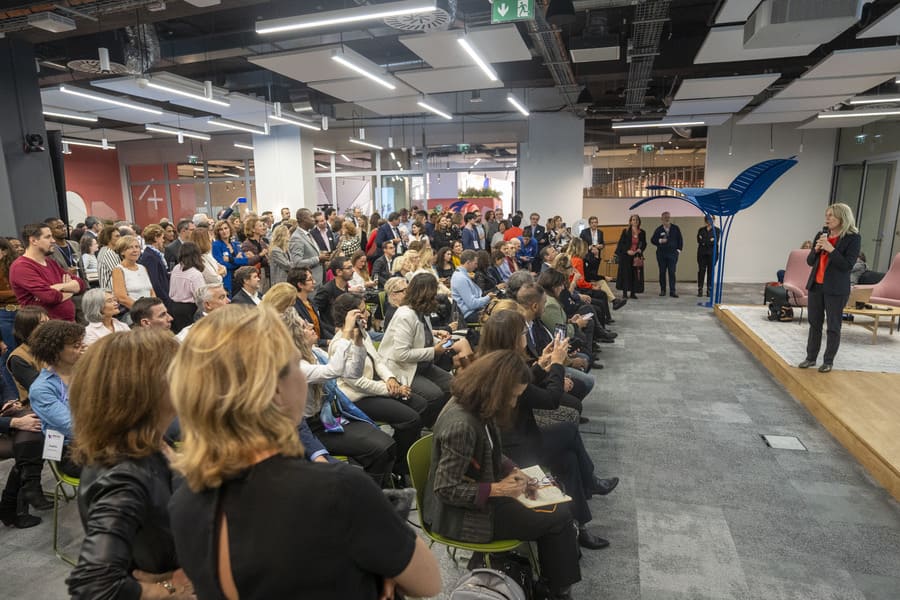
Leadership and Gender: How Can We Overcome Stereotypes?
Female Leadership and Male Leadership
Rather than pitting them against each other, we need to move beyond that. So-called “feminine” leadership—collaborative, emotional, and solution-oriented—is often perceived as less legitimate.
However, in times of crisis, teams led by women have demonstrated greater resilience (Harvard Business Review, 2021).
The goal, then, is not to feminize leadership but rather to make it more diverse. It is about recognizing that different forms of leadership coexist and enrich one another, and that, ultimately, leadership has no gender.
Practical steps to break down gender stereotypes in the workplace
1. Train leadership teams to challenge gender biases
Unconscious biases influence hiring, evaluation, and promotion decisions. That is why raising leaders’ awareness of these mechanisms — by assessing their biases and participating in workshops, certified training programs, and role-playing exercises — helps bring to light discriminatory behaviors that are often invisible or unintentional.
2. Establish gender parity benchmarks and inclusive leadership indicators
What cannot be measured does not exist. It is important to have concrete data to objectively assess the situation: the gender breakdown at each hierarchical level, pay gaps, promotion rates, and perceptions of an inclusive work environment.
These metrics should be shared and managed with realistic goals. Because transparency fosters commitment.
3. Promote role models
Employees need to be able to see themselves in others. Highlighting inspiring leaders from all walks of life helps break down the unspoken norms about “what a good leader looks like.” This can be done through profiles, testimonials, speaking engagements at internal events, or mentoring programs. “If she can do it, so can I.”
4. Establish joint committees in the promotion process
Biases play a significant role in career advancement decisions. Therefore, to ensure fairness, it is essential that career committees be composed of both men and women, trained in objectivity, and guided by transparent criteria. This helps prevent the effects of cronyism or “cloning” candidates (hiring someone who is just like us).
5. Create opportunities for cross-mentoring between female and male leaders
Mentoring is a powerful tool for empowerment. When it involves cross-gender mentoring (men mentoring women, and vice versa), it helps break down silos, share different experiences, and foster mutual understanding. It is also a concrete way to involve men in the transformation process by positioning them as allies of change.
Equality and Diversity: A Key to Success
Gender parity isn’t just a matter of fairness—it’s a matter of strategy. Inclusive companies perform better, are more innovative, and are more attractive. We need to see more of them. Together, let’s commit to making leadership gender-neutral and building a workplace where everyone can reach their full potential.
In conclusion: Act now to build the leadership of tomorrow
Breaking down gender stereotypes in the workplace is both an organizational and a human necessity. It also means recognizing that leadership has no gender and that it has long been shaped by exclusionary norms.
This means acknowledging that there are still systemic barriers to be overcome, and that every employee in the company has a role to play.
We are convinced that change is possible if it is driven by committed leaders and a shared determination to make a difference.
Do you believe that the world of work needs to change? Join the WFCEO movement . Together, we form a committed and united community, ready to build a new generation of inclusive leaders.
Thank you to Pascal Huguet, a research director at the CNRS, for guiding Women for CEO in this work.